Competition Project / Embedded Systems
TI Cup 2026 H Problem: Car-Borne Balancing Ball Motion Control System
A two-layer electromechanical platform combining line following, machine vision, and closed-loop ball balancing.
2026 TI Cup Shanghai Collegiate Electronic Design Competition · H Problem · ShanghaiTech University
H / 2026
Overview
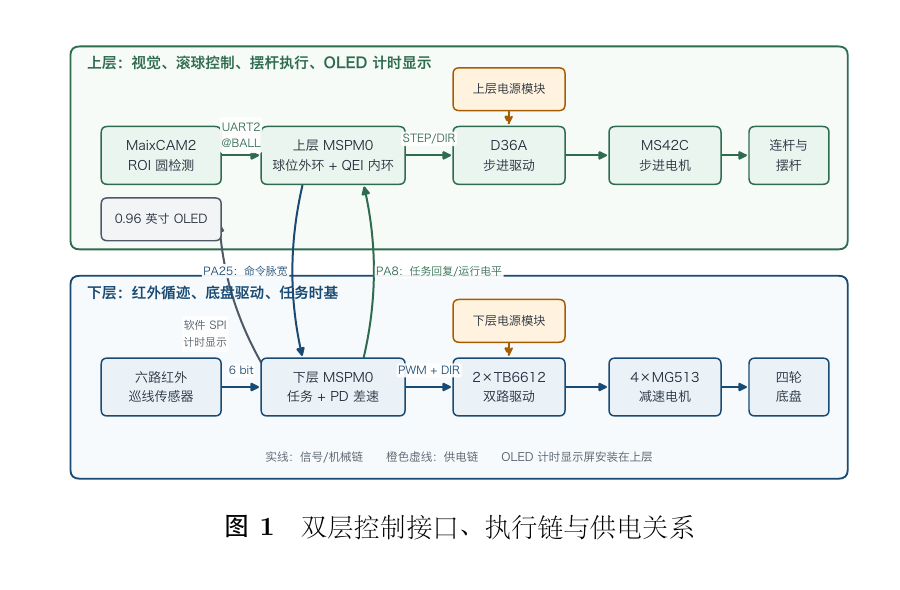
The project implements a two-layer four-wheel vehicle for the H problem of the 2026 TI Cup Shanghai collegiate electronic design competition. The lower layer handles infrared line following, differential drive, task timing, and A-point recognition. The upper layer uses MaixCAM2 to observe the steel ball and controls a longitudinal PPR rail through an outer ball-position loop and an inner QEI position loop.
System Summary
- The lower controller uses a six-channel infrared array, weighted line-position error, discrete PD correction, segmented speed control, lost-line recovery, and task timing.
- The upper controller combines MaixCAM2 circle detection with an MSPM0G3507 controller, D36A stepper driver, MS42C stepper motor, and a linkage-driven rail.
- A two-wire pulse-level interface synchronizes task selection, execution, query, and running-state feedback between the two controllers.
- The vehicle is designed within the 35 cm × 25 cm size constraint and supports six physical task procedures.
System Architecture
The report separates the system into independently running control loops with different time scales, then joins them through task-level synchronization.
Lower Layer / Chassis
- Six-channel infrared line sensor and LP-MSPM0G3507 controller.
- Two TB6612 dual H-bridge drivers and four MG513 geared motors.
- Weighted line error, discrete PD differential drive, speed scheduling, and A-point recognition.
Upper Layer / Ball Control
- MaixCAM2 ROI circle detection and UART2 ball-position frames.
- Ball-position outer loop with QEI position inner loop.
- D36A / MS42C stepper actuation for the longitudinal PPR rail.
Task Synchronization
- Pulse-width commands encode task selection, execution, and query operations.
- The lower layer reports task state and keeps the OLED timing display updated.
- Tasks 1–6 combine chassis motion, ball control, timing, and stopping conditions.
Testing and Results
The report records that all six physical acceptance procedures passed. The clearest quantitative result is the task-2 one-lap run, which finished in 16.8 seconds with a stopping deviation below 1 cm.
H-R1 through H-R6 passed
3.2 s below the 20 s limit
official criterion: ≤ 2 cm
competition size constraint
Physical Acceptance
- H-R1 external display and complete recording: passed.
- H-R2 one-lap line following and stop: 16.8 s, stopping deviation below 1 cm.
- H-R3 fixed-point ball motion, H-R4 A-to-B traversal, H-R5 fixed-point lap, and H-R6 selected-position lap: passed.
Award Record
The official preliminary award list records the team under H problem at ShanghaiTech University. The page shows only the team associated with this project and links the complete source list as a PDF.
Official Team Record
- Problem: H — Car-Borne Balancing Ball Motion Control System.
- School: ShanghaiTech University.
- Students: Song Zidong, Ning Zidong, and Shao Zhengran — Third Prize, preliminary evaluation.
The technical report and official preliminary award list are preserved as the two source documents for this project.
Source and Attribution
Source Note
The technical report is an anonymous design report. The page therefore records the official team membership and competition result without assigning specific engineering tasks to individual students.