Course Project / Medical Imaging
Multi-contrast MRI Reconstruction from Undersampled Data
A BME1312 course project on accelerated MRI reconstruction with multi-modal guidance and unrolled deep reconstruction.
Course project at ShanghaiTech University
BME1312
Overview
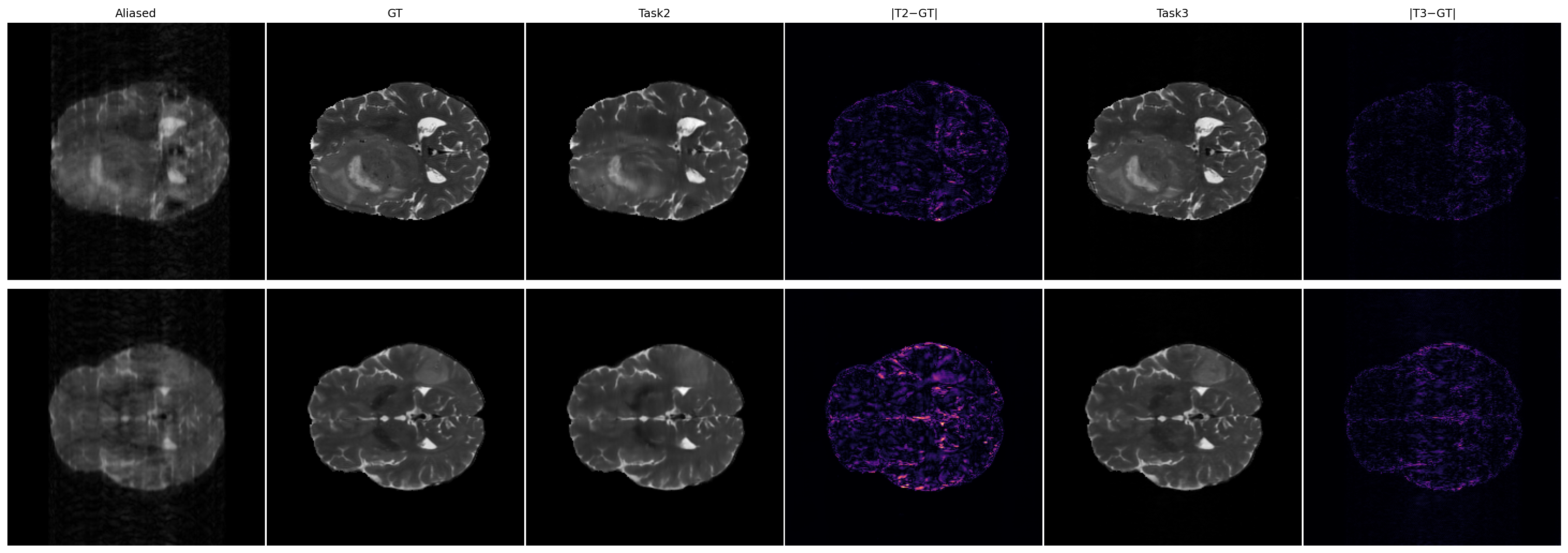
This course project studies accelerated multi-contrast MRI reconstruction from undersampled k-space data. Starting from a single-modal U-Net baseline for T2 reconstruction, we further developed a multi-modal unrolled reconstruction framework that leverages fully sampled T1 images as anatomical guidance for undersampled T2 reconstruction. The model combines feature fusion, iterative data consistency, wavelet-domain constraints, and perceptual objectives to improve both quantitative reconstruction quality and perceptual fidelity.
Summary
- Clinical MRI acquisition can be time-consuming, motivating accelerated acquisition protocols.
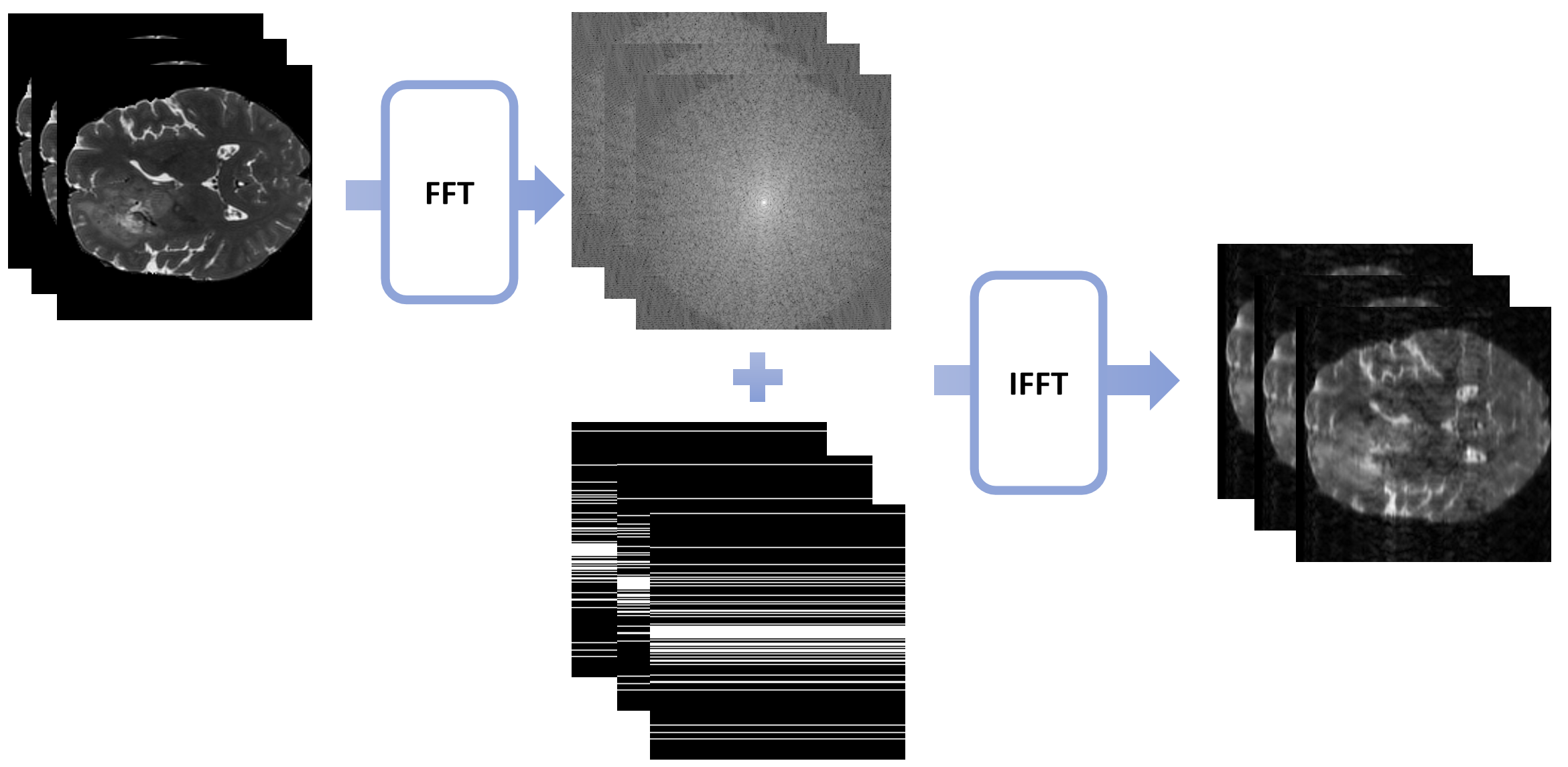
- K-space undersampling reduces acquisition time but introduces aliasing artifacts in reconstructed images.
- The project uses BraTS data to simulate undersampled MRI reconstruction and recover high-quality T2 images.
- The pipeline progresses from a single-modal U-Net baseline to a T1-guided multi-modal unrolled reconstruction network.
Method
Deep learning-based accelerated MRI reconstruction using U-Net baselines, multi-modal fusion, unrolled data consistency, wavelet loss, and perceptual objectives.
Method
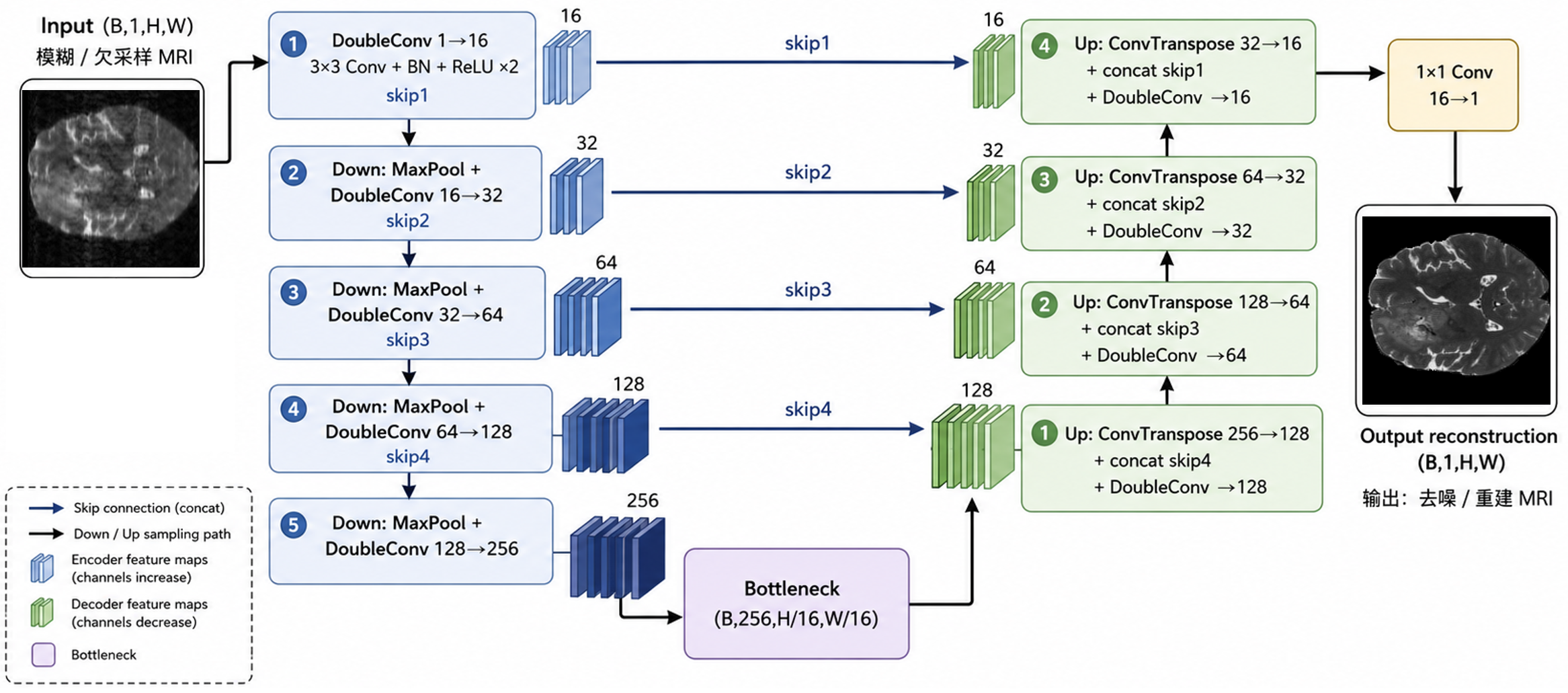
U-Net Baseline
- Single-modal T2 reconstruction from undersampled inputs.
- Encoder-decoder architecture with skip connections.
- L2 / MSE objective as the initial reconstruction baseline.
Method
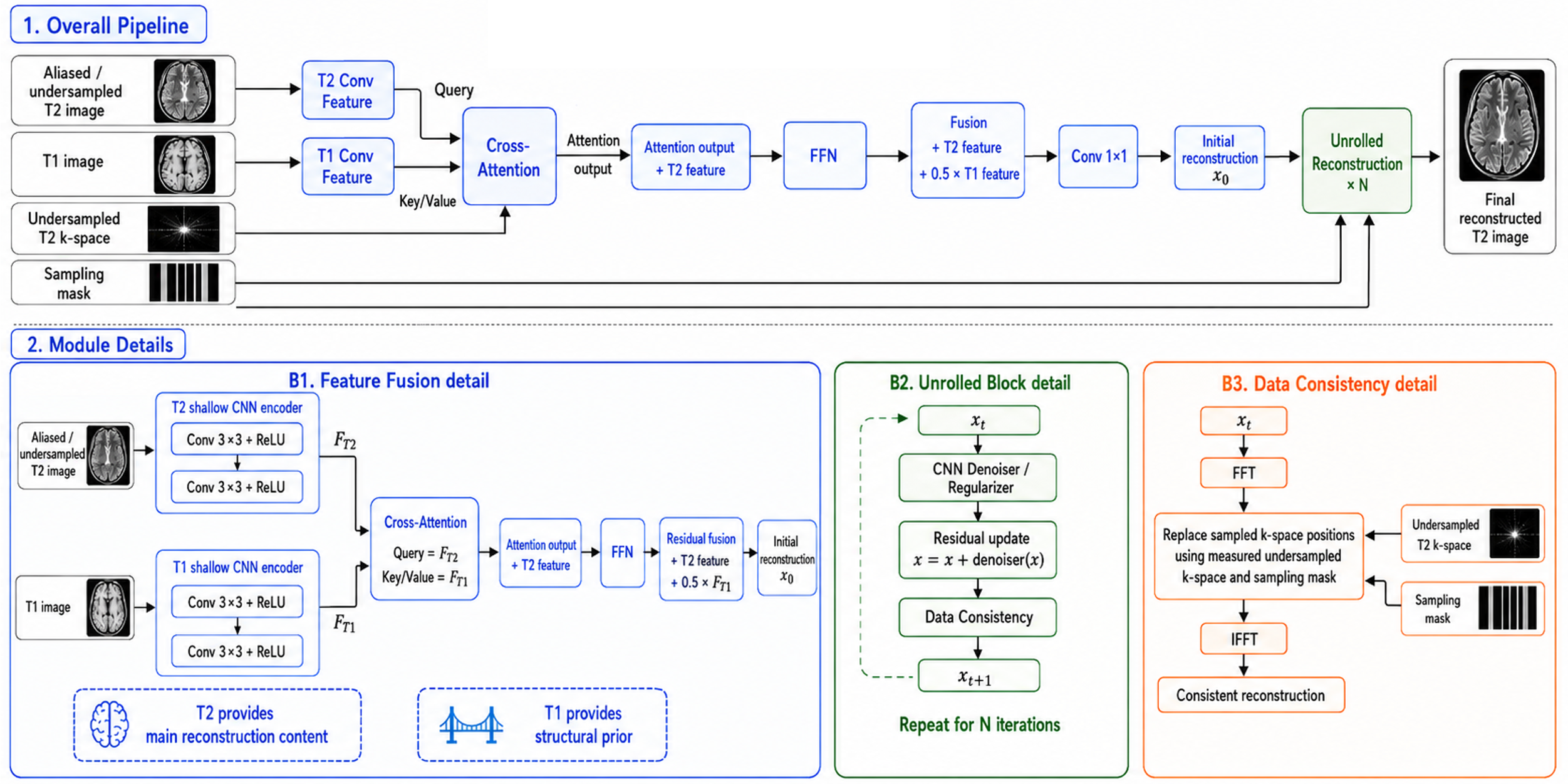
Multi-modal Unrolled Reconstruction
- Uses fully sampled T1 images as anatomical guidance.
- Reconstructs undersampled T2 images with feature fusion.
- Iterative refinement with k-space data consistency layers.
Method
Perceptual and Frequency-aware Objectives
- Wavelet loss encourages high-frequency structure recovery.
- Perceptual loss improves feature-level reconstruction fidelity.
- DISTS and LPIPS complement PSNR and SSIM during evaluation.
Highlights
- Simulated accelerated MRI reconstruction from undersampled k-space data.
- Implemented a U-Net baseline for single-modal T2 reconstruction.
- Built a multi-modal unrolled reconstruction network using fully sampled T1 guidance for undersampled T2 reconstruction.
- Added data consistency layers to enforce k-space fidelity during iterative reconstruction.
- Explored wavelet loss and perceptual loss to reduce over-smoothing and improve high-frequency detail recovery.
- Evaluated reconstruction quality using PSNR, SSIM, LPIPS, and DISTS.
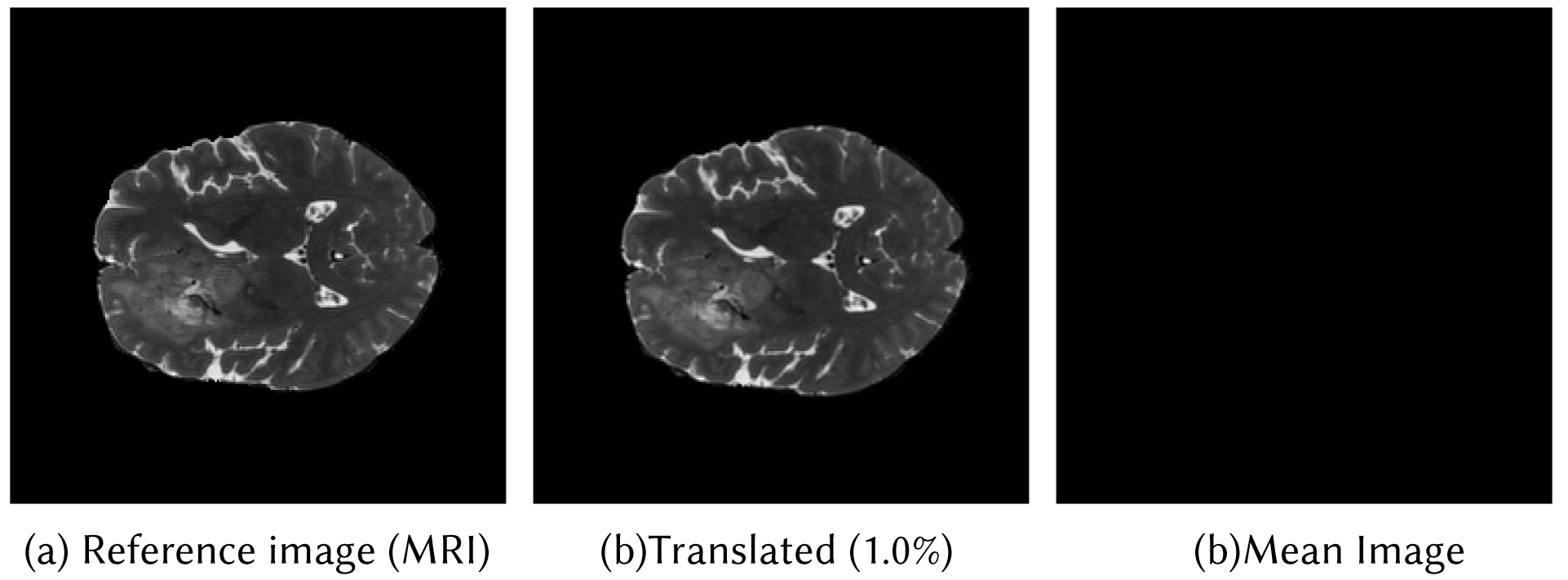
- Analyzed the limitation of PSNR through a pixel-shift experiment.
Results
Compared with the U-Net baseline, the proposed multi-modal unrolled reconstruction framework improves PSNR, SSIM, LPIPS, and DISTS, indicating better pixel-level fidelity, structural consistency, and perceptual reconstruction quality.
Visual gallery
Selected processed figures from the course report, showing data simulation, model design, and evaluation analysis.
My contribution
My work in this team course project involved implementing and analyzing deep MRI reconstruction pipelines, comparing baseline and advanced reconstruction models, conducting experiments with multiple reconstruction metrics, and preparing visual and written analysis for the final report.
Course context
This work was completed as a team course project for BME1312: Applications of Artificial Intelligence in Medical Imaging at ShanghaiTech University. The page intentionally does not expose student IDs or personal emails of other team members.
Future improvements
Better edge-aware constraints.
More robust multi-modal registration.
Stronger frequency-domain modeling.
Validation on broader clinical datasets.